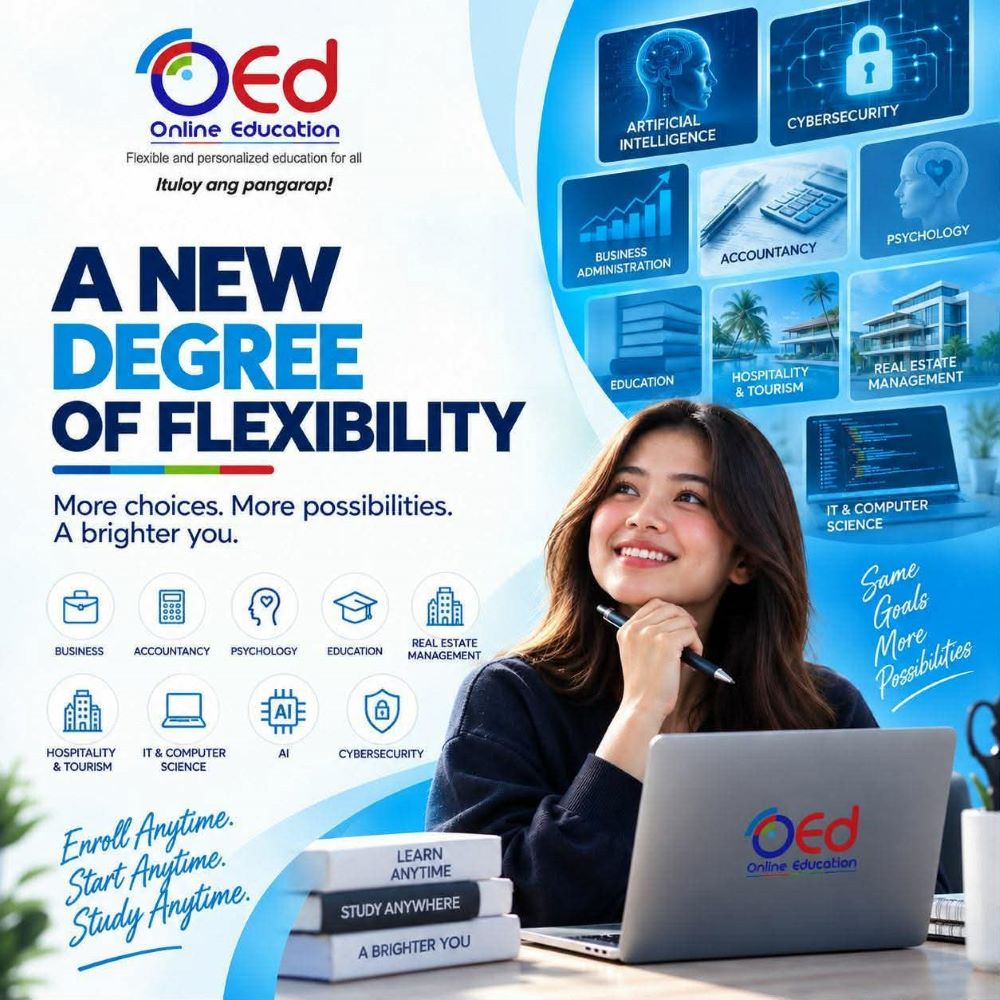
As students increasingly balance school with work, family and other responsibilities, Online Education (OEd) is widening the range of degrees that can be pursued through flexible education—from established professions to emerging technology careers.
For years, choosing a more flexible way to earn a college degree could come with a trade-off: fewer programs to choose from.
That equation is changing.
As work arrangements evolve, technology reshapes industries and more Filipinos seek ways to earn a degree without stepping away from jobs, businesses or family responsibilities, flexible education is moving beyond its role as an alternative to the traditional classroom.
It is becoming an academic pathway in its own right—and one with increasingly diverse choices.
Online Education (OEd) reflects this shift with an undergraduate portfolio spanning business, accountancy, real estate, psychology, education, hospitality, tourism and technology, alongside emerging fields such as artificial intelligence and cybersecurity.
For students, the proposition is increasingly relevant: needing flexibility does not have to mean limiting what they can study.
MORE CHOICES, DIFFERENT CAREER PATHS
OEd’s business programs include the Bachelor of Science in Business Administration (BSBA) with majors in Marketing Management, Financial Management, Human Resource Management and Management Information Systems, providing different pathways into business, management and entrepreneurship.
Students pursuing more specialized professional tracks can also take the Bachelor of Science in Accountancy (BSA) and Bachelor of Science in Real Estate Management (BSREM), including a Fast Track REM option.
Beyond business, OEd offers both the Bachelor of Science in Psychology and Bachelor of Arts in Psychology.
While both are grounded in the study of human behavior, the two programs offer different academic orientations. BS Psychology places greater emphasis on the scientific and research dimensions of the discipline, while AB Psychology combines psychology with a broader liberal arts foundation.
Future educators, meanwhile, can pursue the Bachelor of Elementary Education (BEEd) or Bachelor of Secondary Education (BSEd)—opening another route to a teaching career for learners who may need greater flexibility while completing their degree.
HOSPITALITY AND TOURISM FOR A CHANGING WORKFORCE
The range extends to industries built around travel, service and experiences.
OEd’s Bachelor of Science in Hospitality Management (BSHM) provides a foundation for careers across hotels, resorts and other hospitality enterprises, while the Bachelor of Science in Tourism Management (BSTM) covers areas including tourism operations, travel services and destination management.
For a working student, parent or professional considering a career shift, the significance goes beyond having these programs available. It is having another way to pursue them without necessarily putting other responsibilities on hold.
That matters as the profile of the college learner continues to evolve.
Today’s student may be a fresh senior high school graduate, but could also be an employee working full time, an entrepreneur running a business, a parent returning to school or someone whose location makes regular campus attendance difficult.
The traditional straight line from high school to four years on campus and then employment is no longer the only route to a degree.
FROM IT TO AI AND CYBERSECURITY
Perhaps nowhere is the changing relationship between education and employment more visible than in technology.
OEd offers the Bachelor of Science in Information Technology (BSIT) and Bachelor of Science in Computer Science (BSCS) as fully online degree programs, giving students the option to pursue technology studies without regular physical campus attendance.
BSIT covers areas such as programming, database management, information security and network systems, while BSCS develops foundations in programming, algorithms, data structures, software engineering and computing systems.
But the technology landscape students are preparing to enter is itself changing rapidly.
OEd’s portfolio also includes the Bachelor of Science in Artificial Intelligence (BSAI) and Bachelor of Science in Cybersecurity, bringing two emerging areas of technology into its growing range of degree choices.
The AI program covers fields such as machine learning, data analytics, natural language processing, computer vision and robotics, alongside the responsible and ethical use of artificial intelligence.
Cybersecurity, meanwhile, responds to another reality of an increasingly digital economy: as businesses, government institutions and individuals become more dependent on connected systems and data, protecting that infrastructure becomes increasingly important.
Their inclusion points to a broader development in higher education. Colleges are preparing students not only for established professions, but also for industries and jobs being transformed—or created—by technology.
WHEN FLEXIBILITY BECOMES PART OF THE DECISION
Across these disciplines, OEd’s Flexible Education model is designed for students who need to combine college with other responsibilities.
Its learning platform provides 24/7 access to course materials, giving learners greater control over when they study and complete academic work. BS Information Technology and BS Computer Science are both offered fully online, providing an entirely online option for students pursuing these technology degrees.
The distinction is important.
Flexible education is not about removing the academic requirements of earning a degree. It is about providing another way to meet them—one that recognizes that students do not all live, work or learn under the same circumstances.
Some begin working before completing college. Others return to school years later. Professionals change careers, parents resume interrupted studies, and technology increasingly allows learning to take place beyond the physical campus.
For these students, flexibility can be more than a convenience. It can be what makes continuing their education possible.
And as flexible education becomes part of the wider higher education landscape, the question is evolving from “Can I earn a degree this way?” to something more significant:
“What degree can I earn this way?”
From business administration, accountancy and real estate management to psychology, education, hospitality and tourism—and from information technology and computer science to artificial intelligence and cybersecurity—OEd is widening the answer.
Because as the ways people work and build careers continue to change, the ways they earn their degrees are changing with them.
Because choosing an education that fits your life should not necessarily mean choosing from fewer possibilities.